
Are you rich? Or are you wealthy? Perhaps comfortable. Or you may struggle to make ends meet. As long as you don’t fall into the “poor” category, since that’s where the absolute most expensive life lies. Let’s explore this further.
To diagnose a machine, you have to stand outside its gears. For those of us analyzing this economic landscape from a position of relative financial insulation, distance offers a rare asset: objectivity. When we evaluate fiscal structures from a secure vantage point, our attention naturally fixes on the optimized variables: income brackets, capital gains, and corporate deductions. But a macro-analysis reveals an unmapped, regressive distortion at the bottom. The most punitive tax is the systemic, compounding financial markup on simply existing at the bottom of the socio-economic ladder. Economists call it the “poverty premium,” and it ensures that the less money you have, the more everything costs.
To the upper class, efficiency is automated. To the poor, survival is a fragmented series of expensive, daily micro-transactions. Consider the fundamental mechanics of getting food, shelter, and transport. Wealthy households save thousands annually by purchasing in bulk at wholesale clubs. A poor person rarely commands the lump sum liquidity required to buy a 48-pack of toilet paper or a 20-pound bag of rice, let alone possessing the spare space to store it. Furthermore, without a car, they have to buy at local corner stores where per-unit prices are vastly marked up. Hauling groceries in a cab would ultimately eclipse any theoretical savings elsewhere anyway.
That brings us to the next point: transportation. Lacking the capital to buy a vehicle means relying on public transit. Whereas a commute by car takes a predictable 15 minutes, the transit alternative demands 45 minutes instead. That’s an hour of lost productivity daily. Furthermore, because public transit is notoriously unreliable, planning the commute with a necessary 30-minute buffer eats an additional hour of their day.
There go two hours per afternoon that someone wealthy would never allow to be stolen from their schedule. In economic terms, this is a massive destruction of human capital. It ensures that the baseline labor pool is structurally prevented from upskilling, effectively freezing economic mobility. Clearly, taxi rides for those emergencies when public transit fails to fulfill expectations are never any cheaper than driving one’s own car. And even if they do manage to own a vehicle, their insurance premiums dwarf what a wealthy person pays. Because poverty forces people to let coverage lapse when money gets tight, any gap in their history means the underwriting system treats them as a volatile, high-risk new customer every single time they try to get back on the road. This operates as yet another definitive anchor on social mobility. When a system structurally extracts daily productivity time and liquidates a person's spare capital through administrative penalties, it functions as a gravity well. The structural friction is simply too high for generational velocity to occur. Economic mobility is attainable for some, but unavailable for the poorest.
Along with insurance providers, the rest of the world views poverty as a risk. That includes landlords and financial institutions. That’s why they charge for that risk upfront. Because a low-income renter may lack an immaculate credit score, they are forced to provide multiple months of rent in advance, pay massive security deposits, or simply absorb higher short-term rent just to secure a roof over their heads. Life at the bottom is volatile; hence, missed payments happen. This triggers a cascading lowering of credit scores, which translates directly into skyrocketing interest rates on basic loans, bank overdraft fees, and predatory payday lending. In Canada, payday lending is capped at $14 per every $100 in a two-week period, which mathematically compounds to a staggering 365% annual interest. It is 16 times more expensive than the usual 22% of a credit card, and 36 times higher than the common 10% for a line of credit.
Even the world of charity and cultural institutions features a regressive price tag. High-tier philanthropic memberships to legacy cultural institutions, like the Royal Ontario Museum, offer generous tax receipts. For wealthy individuals in the highest tax bracket, that tax credit effectively cuts the real cost of their membership by more than 50%. For a poor person paying the baseline price, that same tax credit is practically meaningless because their net income tax liability is already near zero. They pay 100% of the sticker price; the wealthy get a half-off discount from their altruism.
This extractive architecture isn't an accident; it is protected by legacy structures that shield the wealthy while offloading systemic risk onto the vulnerable. This is what happens when massive corporate acquisitions fail, such as that of Toys "R" Us. Private equity firms bought the iconic, profitable retailer using billions in borrowed money, instantly strapping that debt directly onto the company’s own balance sheet.
Toys "R" Us was forced to spend its cash paying off the massive interest fees generated by its new owners, rather than investing in inventory, its people, and even air conditioning. When that engineered house of cards inevitably collapsed under its own weight, the wealthy executives walked away insulated with millions already in their pockets, collected in the form of “advisory and management fees” from the company to themselves since day one of acquisition. Thirty thousand employees, ranging from hourly workers to salaried middle managers who felt insulated from volatility, lost their jobs, their benefits, and even their contractually expected severance. The bankruptcy court treats a store manager’s severance package exactly the same as an hourly worker's. They are both unsecured liabilities, vaporized to satisfy senior creditors. From the working class to the managerial elite, everyone below the executive suite paid the price for a gamble they never took.
The ultimate tax, however, is not even monetary; it is cognitive. It is what happens to human development under the crushing weight of survival mode. Take a job at a fast-food chain. The friction isn't the physical labor or the hourly wage structure itself; it is the psychological conditioning. When an individual spends eight hours a day performing hyper-rigid, repetitive tasks under intense surveillance, they are training for compliance, not leverage. Upon returning home, the cognitive surplus required to study market systems, build equity, or exit the loop is entirely depleted.
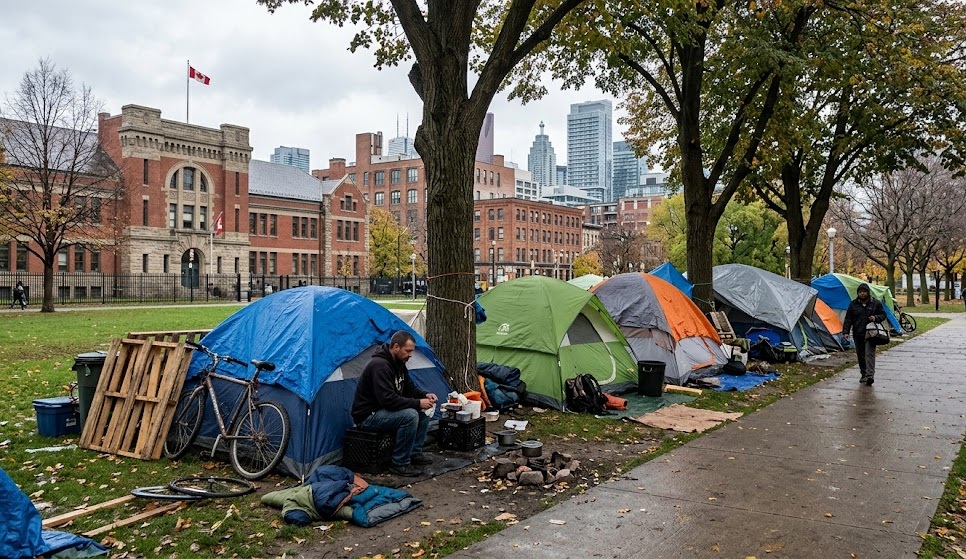
The system eventually snaps for the most vulnerable. This is where homelessness begins. Homelessness is never just an individual's isolated problem or a personal failing; it is the mathematical consequence of a society actively pushing people over the edge through these compounding penalties. Yet, instead of fixing the machinery that broke them, they get patronized. From a position of comfort, society lectures the unhoused on how to live their lives, how to budget money they don't have, and how to achieve higher goals, as if chasing food and shelter didn’t consume their entire thinking power. The comfortable middle class looks at their own stability (their suburban home and their predictable salary) and mistakes a single positive outcome for a universal law of merit. They fail to acknowledge survivorship bias. If a simulation of their lives was run one hundred times—altering just a few systemic variables beyond their control—they themselves would also get crushed by the architecture of the baseline in many of those iterations. Their success is a statistical phenomenon, not a moral certainty.
The Poor People’s Tax is designed to be inescapable. It drains someone’s wallet by the day, their credit by the month, and their cognitive freedom by the decade. To bridge this divide, we don’t need more patronizing lectures or clinical policies; we simply need the intellectual honesty and the empathy to acknowledge the hidden premium. We must stop treating poverty as a personal moral failure, and start recognizing it for what it actually is: the most expensive, exhausting tax model on the planet.